What Makes Dayanand Mukti Dham Different from Older Cremation Grounds: Arya Samaj Cremation Services Delhi
September 11, 2026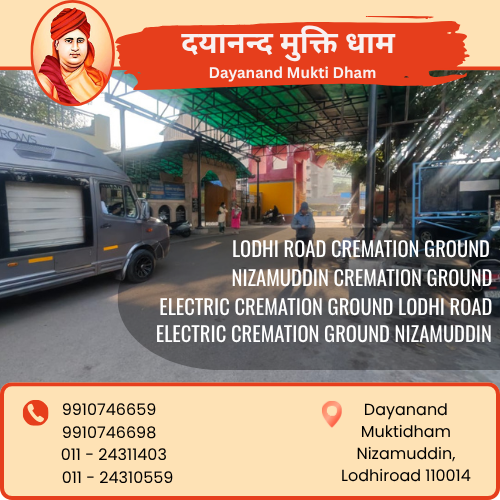
A death in the family is hard enough when everyone lives in the same city. It becomes a second crisis when the nearest son is in Bengaluru, the daughter is abroad, or the only relatives who can perform mukhagni are still on a flight. Hospitals will not wait indefinitely. Airlines and trains run on their own clocks. Documents have to be collected while people are still in shock. What outstation families need is not another directory listing. They need a ground that can act as the local pair of hands until they arrive.
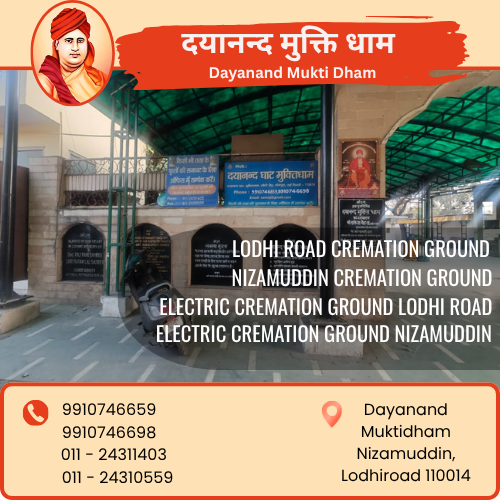
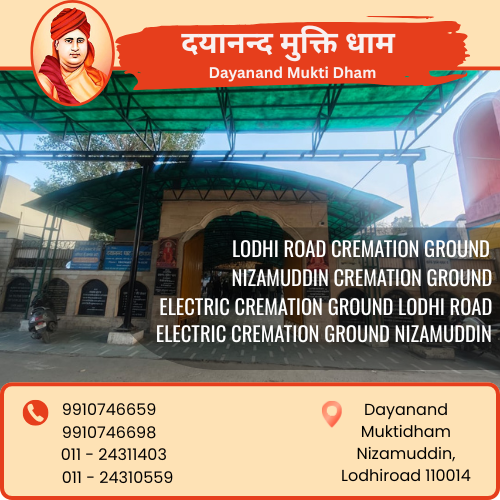
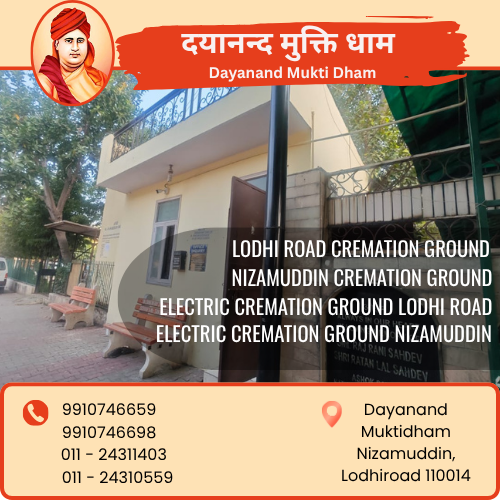
That is the role Dayanand mukti dham plays from Nizamuddin Lodhi Road. People searching on a phone for the best cremation ground near me Delhi are often not “near” at all. They are in another state, looking for a site that can receive the body, preserve it, book a slot, arrange a van, keep the priest ready, and hold the ashes if immersion cannot happen the same day. The sections below explain how those long-distance arrangements actually work.
The real problems outstation families face
Distance creates a fixed list of failures. The body may be in a Delhi hospital while the family is still buying tickets. There may be no one in the city who knows how to obtain the medical certificate, photo ID check, and police papers if the death was unnatural. Wood, a hearse, and a pandit cannot be assembled from a WhatsApp group at 1 a.m. Relatives who do reach Delhi may have only a few hours before they must fly back. If the Yamuna or another tirtha is not possible that day, there is nowhere safe to keep the asthi.
Older, thinly staffed grounds leave all of this to the family. Dayanand Mukti Dham is set up so the family can stay on the phone for the first hours and on the premises only when the rite itself begins.
One call that starts the local chain
The first step is not arriving at the gate. It is calling 9910746659, 9910746698, 011-24311403, or 011-24310559 and reserving a slot. Staff ask the basic facts: where the departed is now, whether a freezer box is needed at home or at the hospital, which relatives are travelling and when, and whether the family wants a traditional pyre, Mokshda, or electric cremation.
For someone typing the best cremation ground near me Delhi from another city, that phone conversation is the difference between a plan and a scramble. Photo ID of the departed will be required on arrival for verification. If a medical certificate or additional papers are still pending, the team can tell the family what to collect before they leave the hospital or the airport.
Timings on the ground are listed as 7 AM to 7 PM, every day of the week. The supporting services—hearse, freezer box, companion staff—exist so the family does not have to treat those hours as the only window in which anything can be organised.
Preservation and transport when the family is still in transit
The freezer box is the most important tool for long-distance cases. It can be delivered to the home or used to bridge the hours between hospital release and the booked slot. Relatives flying in from Pune, Kolkata, or overseas do not have to force a cremation before the person who must light the fire has landed.
Hearse vans and antim yatra vehicles move the departed from hospital, residence, or another city point to Lodhi Road with dignity. Outstation families should not be asked to find a private ambulance through an unknown broker at the worst moment. Coordinated pickup is part of why people who do not live in Nizamuddin still treat this site as the best cremation ground near me Delhi when the death has occurred in the capital.
Two caring staff members and a dedicated funeral companion stay with the process so the person on the phone is not giving instructions into a void. Someone on the ground can confirm that the body has been received, that the slot is held, and that the priest and samagri will be ready when the flight lands.
Choosing a method that matches a short stay in Delhi
Outstation mourners often have a return ticket the next morning. A conventional open pyre that runs for hours, or a delay caused by rain and wet wood, can break that plan. Dayanand mukti dham keeps three options on the same premises.
Electric cremation is typically the fastest enclosed process and does not depend on dry timber. Mokshda keeps the sacred fire while using about 200 kg of wood instead of roughly 400 kg on a conventional stack. Traditional wooden pyres remain available for families who will not accept any other form. About 32 wooden platforms give the ground capacity that a small local shamshan cannot match during a busy day.
Priests can still conduct antim sanskar, including regional variations, before either the pyre or the furnace. The prayer hall gives arriving relatives a sheltered place to gather instead of standing on an open plot after a night flight. Flowers, clothes, mango leaves, ghee, and an urn can be taken from the on-site shop so no one has to locate a market in an unfamiliar neighbourhood.
Papers, ashes, and the days after the rite
Guidance in securing the death certificate matters more when the family does not have a local relative who already knows the municipal sequence. Staff who handle this regularly save outstation mourners from a second trip to Delhi only for paperwork.
If asthi visarjan cannot be done immediately—because elders are still travelling, because the chosen river is unsafe, or because the family will take the ashes to Haridwar or their native place later—the asthi locker offers short-term, secure storage. That facility is easy to overlook until it is needed. For a family that must leave the city the same evening, it is often the reason they can complete the cremation without rushing the immersion.
Dayanand Mukti Dham is operated by Arya Samaj Lodhi Road, Jor Bagh. Arya Samaj families from other states find kunds and a familiar ritual form waiting for them. Other communities are received as well. The point for long-distance arrangements is not only philosophy. It is that the ground already knows how to run a complete rite for people who did not grow up on the next street.
Why location still matters when you are not local
Nizamuddin Lodhi Road is inland, not a Yamuna-side ghat that has had to shut when the river rises. It is reachable from South Delhi, central neighbourhoods, and the main hospital and airport corridors. Expanded parking—described in civic upgrade plans as space for around 100 vehicles—matters when several outstation cars and a hearse arrive together.
People use the phrase best cremation ground near me Delhi as a search, not as a claim that one site is nearest to every pin code. What they mean is: a ground I can trust from far away, that will still be functioning when I land, and that will not leave my parents standing in the rain with no van and no priest. Dayanand mukti dham answers that meaning with process rather than with slogans.
A practical sequence for families outside Delhi
Call as soon as the death is confirmed and say that the family is outstation. Ask for freezer-box timing, hearse pickup point, and the next available electric or wooden slot. Send a clear photo of the departed’s ID and confirm who will perform mukhagni. Ask the companion to hold samagri and the priest against the flight arrival. After the rite, decide whether ashes go with the family that day or into the locker.
None of this removes grief. It removes the avoidable work of building a funeral from another time zone.
For households across India who must arrange last rites in the capital, Dayanand Mukti Dham is useful because it treats distance as a design problem: preserve the body, move it, book the method, house the mourners for a few hours, complete the fire or the furnace, store the asthi if needed, and send the family home with the papers in order. That is what long-distance support looks like when someone far from Lodhi Road is still searching for the best cremation ground near me Delhi and needs the search to end in a working plan, not another unanswered number.