Eco-Friendly Last Rites: How Dayanand Mukti Dham Balances Tradition and Electric Cremation in Delhi
September 10, 2026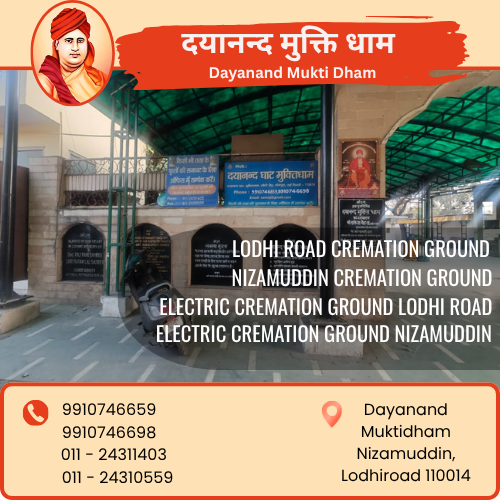
Delhi’s cremation grounds are not interchangeable. Some are centuries-old riverbank ghats where pyres have burned in the open for generations. Others are municipal plots that grew with the city but still run on the same limited model: a few platforms, uneven shade, and families left to assemble wood, a priest, a van, and documents on their own. Dayanand mukti dham at Nizamuddin Lodhi Road belongs to a third category. It is a working cremation ground with traditional fire, yet it is organised, option-rich, and rooted in Arya Samaj practice rather than in the unplanned layout of an older ghat.
That difference is not marketing language. It shows up in who operates the site, which rites can be performed without improvisation, how many methods of cremation sit side by side, and how much of the logistics a grieving family still has to solve in the street.
An Arya Samaj ground, not an anonymous municipal yard
The most important distinction is institutional. Dayanand Mukti Dham is owned and operated by Arya Samaj Lodhi Road, Jor Bagh. Older grounds in Delhi are often run by the municipal corporation, a local panchayat, or an informal caretaker arrangement. The Arya Samaj link shapes the ritual atmosphere. Vedic mantras, a simpler antim sanskar, and designated kunds for Arya Samaj fire rites are part of the design, not an afterthought hired at the gate.
Families who specifically search for Arya Samaj cremation services Delhi come here because the philosophy and the place match. The ground still welcomes people of every community and faith. The difference is that Arya Samaj families do not have to explain their form of the rite to a priest who only knows a different regional sequence. Two special kunds are maintained for those rituals. A prayer hall gives a contained space for gathering, rather than a strip of open ground beside a public road.
For households that want both the Arya Samaj form and a well-kept site in central-south Delhi, that combination is rare. Many older grounds can provide a pyre. Far fewer can provide a coherent Arya Samaj setting with staff who already know the sequence.
More than one way to complete the last rite
An older cremation ground in Delhi typically means an open wooden pyre and, if the family is lucky, a priest on call. Dayanand mukti dham lists three paths on the same premises.
Traditional wooden cremation remains available, with a large number of pyres—about 32 platforms in published descriptions of the site. Mokshda, the greener wood system, uses a more efficient grate and hood so the same sacred fire can be completed with roughly 200 kg of wood instead of the 400 kg common on a conventional stack. Electric cremation offers an enclosed, quicker, low-smoke process that does not depend on dry timber or clear weather.
That menu changes the family’s day. At an older ghat, rain, wet wood, or a long queue can stall everything. Here, staff can move a family toward Mokshda or the furnace without sending them across the city to another complex. Eco-conscious relatives and elders who insist on an open fire can stand on the same ground and still find a method they can accept.
Older riverbank sites have other vulnerabilities. When the Yamuna rises, grounds such as Nigambodh have had to halt work. Lodhi Road is inland. It is not immune to Delhi’s waterlogging, but it is not a floodplain ghat. For families comparing reliability, that geography is part of what makes Dayanand Mukti Dham different.
Infrastructure that treats mourners as people, not a queue
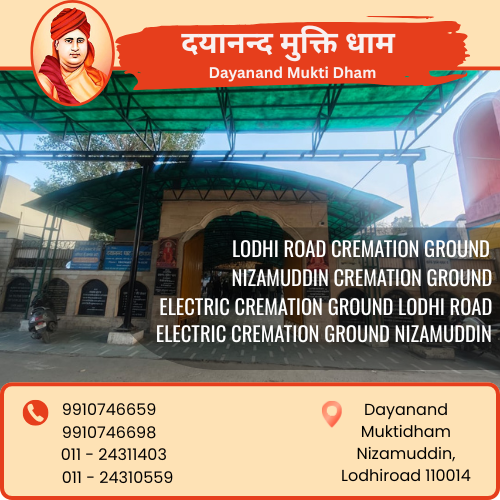
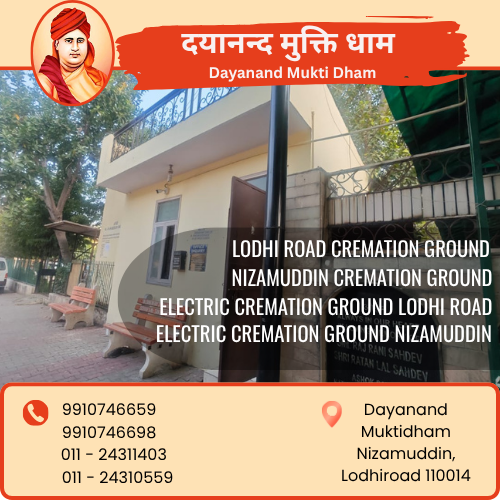
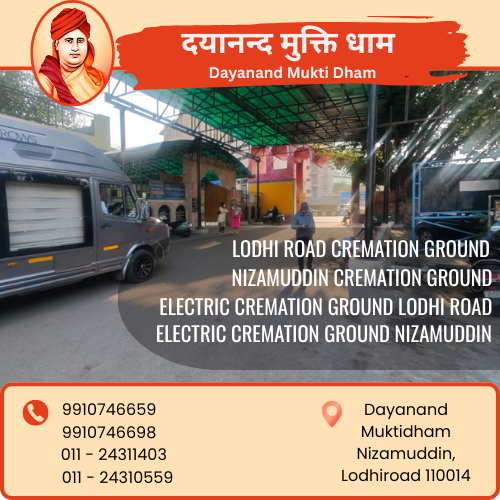
Civic upgrades at the Lodhi Road complex have added parking for around 100 vehicles, better lighting, visitor sheds, drainage-related work, toilets, and office space. Older grounds often still ask families to park on the verge, stand without shade, and walk uneven paths with a bier.
On site, Dayanand mukti dham also keeps the practical pieces that older plots frequently lack in one place: a shop for antim sanskar samagri, an asthi locker for short-term storage of ashes, hearse and antim yatra vans, freezer-box delivery to the home if relatives are still travelling, and staff assigned to walk the family through paperwork. Photo ID of the departed is required for verification. Timings are published as 7 AM to 7 PM, seven days a week.
The process is described in steps rather than left to guesswork: arrival and reception, formalities, preparation of the body, the cremation itself, collection of ashes, and aftercare guidance including help with the death certificate. Two supporting staff members and a dedicated companion are part of the service model. That is a different experience from an older ground where the family must separately book a van, find wood, locate a pandit, and discover only on arrival that the next slot is hours away.
Ritual competence without the scramble
Arya Samaj cremation services Delhi are only useful if the priests and the layout support the rite from start to finish. At this ground, pandits can guide mukhagni, mantras, and related steps, including regional variations when the family is not Arya Samaj. Flowers and garlands, clothes, mango leaves, ghee, and an urn can be arranged without a second trip across town.
Older grounds sometimes offer a priest and nothing else. The family becomes the project manager. Dayanand Mukti Dham is built so the family can remain the mourner. That is a cultural difference as much as an operational one. Last rites are not improved by forcing relatives to bargain for logs while they are still in shock.
The same logic applies after the fire. If immersion in a sacred river cannot happen the same day—weather, travel, or family arrival—the asthi locker prevents ashes from being carried home in an unsuitable way. Older sites may have no formal storage at all.
Location and who the ground actually serves
Nizamuddin Lodhi Road, entered via Lala Lajpat Rai Road, sits within reach of South Delhi and adjoining central neighbourhoods: Nizamuddin, Lodhi Colony, Jor Bagh, Defence Colony, Lajpat Nagar, and nearby areas. Older famous grounds pull people from across the city because of history or the river. This site pulls people because it is organised, close, and aligned with Arya Samaj practice.
It has also long been a place where high-profile farewells occur, which forced the complex to maintain a more orderly public face than a purely local shamshan. Parking, lighting, and crowd movement matter when many vehicles arrive at once. Families who are not public figures benefit from the same order.
What “different” should mean on the worst day
Difference is easy to claim and hard to feel. On the day of a death, it should mean fewer phone calls, fewer surprises, and a rite that matches the family’s belief.
Dayanand mukti dham is different from older cremation grounds in Delhi because it is an Arya Samaj institution with kunds and a prayer hall, not only a row of platforms. It is different because wood, Mokshda, and electric methods exist together. It is different because transport, freezer box, samagri, priests, parking, and ash storage are treated as part of one service rather than a scavenger hunt. And it is different because Arya Samaj cremation services Delhi are the native language of the ground, not a rented add-on.
None of that replaces grief. It only removes the avoidable chaos that older, thinner infrastructure still asks families to absorb.
To reserve a slot or ask which method is available that day, families can call 9910746659, 9910746698, 011-24311403, or 011-24310559. Bring the required photo ID of the departed. Say whether you need the kund, a traditional pyre, Mokshda, or the furnace. The point of a modern Arya Samaj ground is that those questions have answers on the same premises.
For anyone comparing a historic ghat with a maintained, multi-option site, the choice is not tradition versus modernity. It is whether tradition is supported by systems that still work in today’s Delhi. That is the standard against which Arya Samaj cremation services Delhi at Dayanand Mukti Dham should be judged—and the reason many families no longer treat the oldest ground as the automatic one.