How Dayanand Mukti Dham Helps Families at a Cremation Ground in South Delhi During Monsoon and Extreme Weather
September 8, 2026
What Makes Dayanand Mukti Dham Different from Older Cremation Grounds: Arya Samaj Cremation Services Delhi
September 11, 2026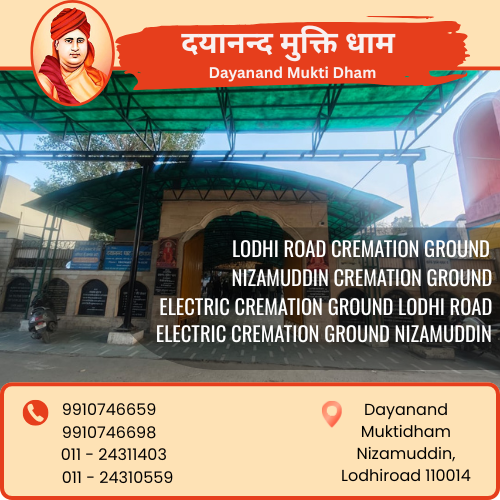
Last rites are among the most sacred duties a family performs. They are also, in a crowded city like Delhi, one of the most resource-intensive. A conventional open wooden pyre can consume 400–500 kg of timber, send smoke and fine particles into already strained air, and keep mourners outdoors for hours. Many households now want the same Vedic dignity—mukhagni, mantras, pind daan, collection of asthi—without adding another load to the city’s trees and lungs. That is the balance Dayanand mukti dham is built to offer at Nizamuddin Lodhi Road.
Operated by Arya Samaj Lodhi Road, Jor Bagh, Dayanand Mukti Dham keeps the full traditional path available and, beside it, two lower-impact paths: the Mokshda green pyre and electric cremation in Delhi. Families are not forced to choose between faith and the environment. They are given clear options, priests who can work with either method, and staff who handle transport, paperwork, and aftercare so the ritual itself stays the centre of the day.
Why the environmental question can no longer be postponed
Civic estimates for Delhi have long pointed to the scale of wood use. Tens of thousands of wood-based cremations a year, at several hundred kilograms each, add up to thousands of tonnes of timber. Studies have also linked open pyres to local emissions of particulate matter and carbon monoxide. The National Green Tribunal and municipal bodies have, for years, asked cities to expand non-wood options. Green methods still account for only a modest share of all cremations in the capital, which is why every well-run site that actually offers those methods matters.
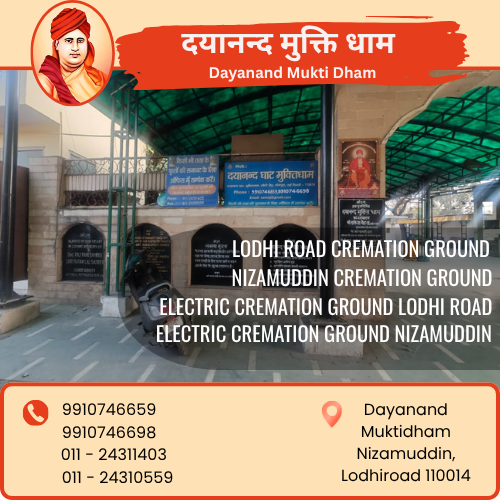
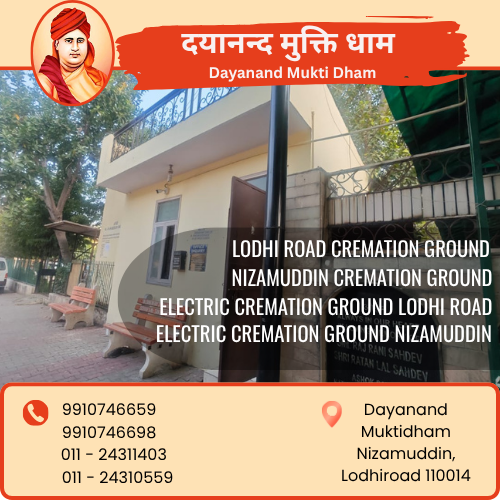
Dayanand mukti dham sits inland at Lodhi Road rather than on a riverbank ghat. It has traditional platforms, Mokshda units designed to burn more efficiently with less wood, and an electric furnace. That mix is the practical answer: keep the fire ritual for those who need it, and keep a cleaner enclosed process for those who want to spare trees and reduce smoke.
Electric cremation: no wood, less local smoke, less time
For families whose first priority is the smallest on-site footprint, electric cremation in Delhi at this ground is the strongest option. No timber is stacked. The process takes place inside a furnace, so rain, wind, and open-air smoke are taken out of the equation. Completion is typically far quicker than an open pyre—often in the range of about an hour to an hour and a half rather than several hours—which also shortens the time elderly mourners must wait.
The official description used by Dayanand Mukti Dham is straightforward: a modern, environment-friendly, pollution-reduced, quick and clean system. In everyday terms, that means no cartloads of logs, no wet wood failing in monsoon, and no dense plume hanging over the gathering. Priests can still conduct the essential rites before the chamber is used. The chief mourner can be guided through the symbolic lighting or initiation. Ashes are collected afterward and can be placed in an urn or held in the asthi locker if immersion has to wait.
Choosing electric cremation in Delhi here does not require a family to abandon Hindu or regional custom. It requires only a decision that the sacred fire can be honoured in a form that does not consume a small grove of trees.
Mokshda: tradition with half the timber
Not every family is ready to leave the open fire. For them, Mokshda is the middle path. The system uses a controlled grate, better airflow, and a hood so heat is not wasted. Dayanand Mukti Dham states that Mokshda uses about 200 kg of wood per cremation against roughly 400 kg on a conventional pyre. Other published figures for Mokshda-type units in Delhi fall in a similar reduced range. The fire remains visible. Mukhagni remains a family act. Mantras remain the same. The difference is efficiency: less wood, less time, less uncontrolled smoke than an old-style open stack.
The ground lists around 32 wooden pyres in all, with Mokshda among the eco-oriented units. That capacity means a family that arrives during a busy period is less likely to be told that the only remaining slot is one they do not want. Tradition is not rationed; it is offered in a form that wastes less.
Rituals, priests, and the feeling of a complete antim sanskar
Eco-friendly last rites fail if they feel incomplete. Dayanand mukti dham treats that risk as part of the service design. Seasoned pandits guide antim sanskar, including regional variations. The prayer hall gives a sheltered place for gathering and initial rites. Kunds on the premises serve Arya Samaj fire rituals. Flowers, garlands, kurta-pyjama, mango leaves, ghee, and urns are available from the on-site shop so families do not have to hunt for samagri across the city.
Whether the family chooses a Mokshda pyre or electric cremation in Delhi, the sequence is held together by staff: reception, verification with photo ID of the departed, preparation of the body, the rite, collection of ashes, and guidance on the death certificate. Hearse vans and antim yatra vehicles bring the departed with dignity. A freezer box can be arranged at home if relatives are still travelling or if documents are delayed. Two supporting staff members stay with the family so no one is left guessing the next step.
That human layer is what makes an “eco” option feel like a last rite rather than an industrial process.
How to choose without guilt
There is no single correct choice. A useful way to decide is to name the family’s two highest values.
If the highest values are zero wood and the least smoke at the ground, choose the furnace. If the highest values are a visible sacred fire and a pyre the eldest son can light, choose Mokshda rather than a full 400-kg stack. If elders insist on the oldest form and the family can accept the timber cost, the traditional platforms remain. Dayanand Mukti Dham does not disappear any of those paths. It simply makes the lower-impact paths easy to take.
Cost is often comparable once wood is counted. Electric slots avoid the timber bill. Mokshda reduces it. Transparency at booking—call 9910746659, 9910746698, 011-24311403, or 011-24310559—lets the family know what is available that day before they arrive. Timings are listed as 7 AM to 7 PM, every day of the week.
A farewell that does not ask the city to pay twice
Delhi cannot plant trees as fast as open pyres can consume them, and it cannot clear its air if every farewell adds another plume. Individual families should not have to solve a civic problem on the worst day of their lives. What they can do is use a ground that already installed the alternatives.
Dayanand mukti dham at Nizamuddin Lodhi Road is one of those grounds. It keeps wooden cremation for those who need the oldest form. It offers Mokshda for those who want the fire with fewer trees lost. And it offers electric cremation in Delhi for those who want the cleanest on-site process the facility can provide, with priests, transport, a prayer hall, and an asthi locker still in place.
Eco-friendly last rites are not a rejection of tradition. They are tradition asked to live in the city that now exists—scarce woodland, fragile air, and families who still deserve a dignified, complete farewell. When those two truths are held together, the rite can honour both the person who has gone and the world that remains.