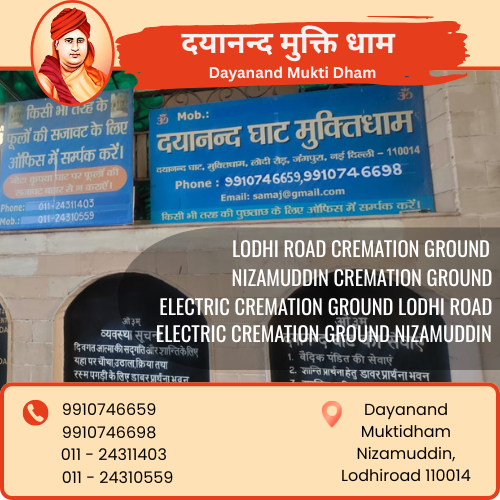
Arya Samaj Perspective on Simple and Meaningful Antim Sanskar Services in Delhi at Dayanand Mukti Dham
November 3, 2026
A cremation ground can provide platforms, a furnace, and a hall, and still leave a family unsure what to do next. The gap between arriving with the departed and completing antim sanskar with confidence is often filled by the Vedic pandit. Not as a performer of empty formality, but as the person who holds the sequence when grief has disordered memory.
Dayanand mukti dham at Nizamuddin places priestly guidance inside the working life of the cremation ground Lodhi road. Operated by Arya Samaj Lodhi Road, Jor Bagh, the ground offers traditional wooden cremation, Mokshda, electric cremation, kund-related facilities, and staff support. This article focuses on what Vedic pandits actually do there—and why their role remains central even when families choose modern methods.
The pandit as keeper of sequence
Most first-time arrangers do not lack devotion. They lack sequence. They do not know when to step forward, what must be said, how mukhagni is initiated for their method, or which acts belong at the ground and which belong later.
A Vedic pandit restores order without requiring the family to become ritual experts overnight. At Dayanand mukti dham, that guidance typically covers preparation orientation, mantras, the family’s participatory moments, and the transition toward completion and asthi collection. In a busy cremation ground Lodhi road setting, this prevents parallel advice from relatives from turning into conflict at the platform edge.
Why Vedic guidance fits the Arya Samaj character of the ground
Arya Samaj-linked antim sanskar tends to value intelligibility: mantras with purpose, duty without compulsory excess, and a rite that can be understood rather than merely displayed. Vedic pandits at Dayanand Mukti Dham work within that climate. Families who want elaborate regional additions should say so early; families who want a clean, essential sequence can also be served without pressure to inflate the programme.
The ground’s kund-related provision supports rites that need that setting. The prayer hall gives the pandit and family a place to align before the most intense outdoor or process stages. Infrastructure and priesthood function together; neither replaces the other.
Stage by stage: where the pandit changes the day
Before the rite begins
The pandit helps identify who will take the chief role, what the chosen method implies for participation, and whether any family-specific custom must be accommodated. This short alignment prevents public hesitation later.
During preparation
Guidance keeps actions purposeful. The family is not left copying neighbours at the next platform. In a cremation ground Lodhi road environment where several farewells may proceed in parallel, that local instruction is steadiness.
At the central act
For wood-based cremation, including traditional pyres and Mokshda, the pandit supports the fire-centred sequence and the chief mourner’s role in mukhagni. For electric cremation, the pandit helps the family understand method-appropriate initiation and presence so the rite does not feel emptied of participation. The engineering differs; the need for guided responsibility remains.
After completion
Priestly clarity helps families transition to asthi collection and next steps—whether immersion is planned the same day or later. The pandit does not replace staff logistics, but can reduce ritual anxiety at the boundary between cremation and what follows.
Working with family priests and on-site pandits
Some households bring their own priest. Others rely on arrangements available through the ground. Both patterns can work when communication is clean.
If you are bringing a family pandit, inform Dayanand mukti dham at booking so roles do not clash. If you need an on-site Vedic pandit, request that explicitly when you call 9910746659, 9910746698, 011-24311403, or 011-24310559. Ambiguity creates the only true problem: two authorities giving different instructions at the same moment.
A competent cremation ground Lodhi road process treats priesthood as a scheduled support, not a chance meeting at the gate.
Method choice and the pandit’s adaptive role
Traditional wooden cremation
Here the pandit’s role is most familiar to families raised with open-fire antim sanskar. Timing, mantras, and mukhagni are guided in a setting of platforms and fire.
Mokshda
Still fire-centred, often with a more efficient wood load—commonly described as around 200 kg rather than roughly 400 kg. The pandit helps the family retain the meaning of the fire while following the practical form of the system.
Electric cremation
The pandit protects meaning when the process is enclosed and shorter. Families who fear that electric means “no ritual” usually need explanation more than persuasion. Guided participation is the answer.
Across methods, photo ID of the departed and proper medical formalities remain required. The pandit cannot waive legal process; the pandit makes religious process navigable once formalities are complete.
What the pandit is not responsible for
Clear boundaries prevent unfair expectations.
The pandit is not the hearse dispatcher.
The pandit is not the substitute for hospital documentation.
The pandit is not a mediator for deep family property disputes that erupt at the ground.
The pandit is not obliged to perform every regional variation without being told what the family actually practices.
Dayanand mukti dham works best when families use staff for logistics and the Vedic pandit for ritual sequence. Confusing the two roles slows both.
Helping elders and first-time chief mourners
Elders often fear that younger relatives will “do it wrong.” First-time chief mourners often fear the same about themselves. The pandit’s calm instruction reduces both fears. A short explanation before the critical moment is more valuable than a long lecture after mistakes.
At the cremation ground Lodhi road campus, the prayer hall is useful for this briefing. Standing at the edge of an active platform is a hard classroom. A few minutes of prior orientation protects dignity.
How to prepare so the pandit’s role is effective
- Decide method before arrival when possible.
- Name the chief mourner and one logistics coordinator.
- Tell the pandit your community custom in one clear paragraph, not five competing speeches.
- Arrive within operating hours—commonly listed as 7 AM to 7 PM, seven days a week—with documents ready.
- Ask what the family must do, not only what the pandit will chant.
- Keep phone distractions down during the central sequence.
These steps make Vedic guidance effective rather than ornamental.
Why priesthood still matters in a modern facility
Modern facilities can tempt families to treat antim sanskar as pure process engineering: book, burn, collect. Process engineering is necessary and Dayanand mukti dham invests in it. Yet many families still need a human channel for sacred duty. The Vedic pandit is that channel—especially for those who want Arya Samaj-aligned clarity rather than either empty minimalism or unexamined excess.
In that sense, the pandit is not an add-on to the cremation ground Lodhi road experience. The pandit is part of how the ground remains a place of antim sanskar rather than only a place of disposal.