How to Pre-Plan Final Rites at Dayanand Mukti Dham, a Trusted Cremation Ground in South Delhi
October 6, 2026
Electric vs Traditional Wooden Cremation: Choosing with Arya Samaj Cremation Services Delhi at Dayanand Mukti Dham
October 10, 2026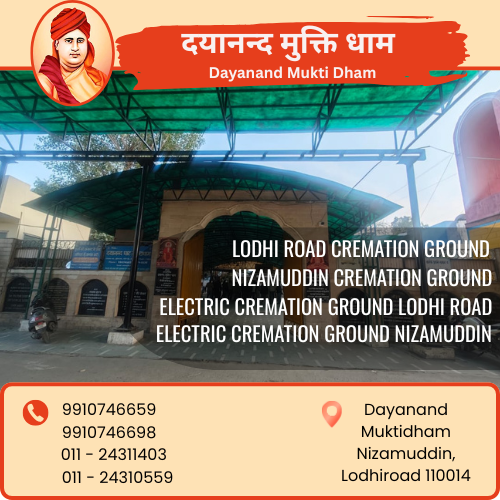
The most common delay at a cremation ground is not the fire and not the furnace. It is paperwork. Families arrive grieving, carrying the departed with care, and then discover that one card, one certificate, or one police note is missing. The slot waits. Relatives wait. The day hardens around an avoidable gap.
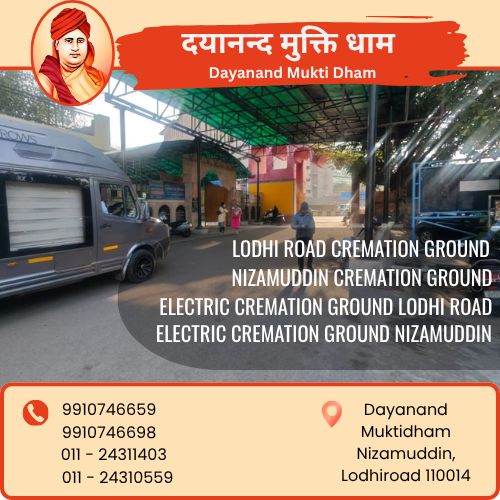
Dayanand mukti dham at Nizamuddin Lodhi Road runs an orderly process, but order still depends on verification. Operated by Arya Samaj Lodhi Road, Jor Bagh, the ground offers traditional wooden cremation, Mokshda, and electric cremation in Delhi, along with hearse support, freezer-box arrangements, a prayer hall, pandit guidance, and asthi storage. This guide focuses only on the documents that make those services possible without last-minute panic.
Why documents sit at the centre of antim sanskar
Cremation is both a ritual and a legal event. The ground must confirm the identity of the departed. Municipal and medical systems must record the death. In some cases, the police must clear the way before any rite begins. None of this is designed to obstruct families. It is designed to prevent error in a moment when error is irreversible.
When people choose electric cremation in Delhi, they often do so because it is faster and more predictable once the process starts. That advantage disappears if the family spends the morning chasing a missing ID across the city. Documents are what allow speed to remain meaningful.
The core set almost every family needs
At Dayanand mukti dham, the non-negotiable starting point is photo ID of the departed. Staff use it for respectful verification before the rite proceeds. Keep the original ready, not only a phone photo. A clear copy can help as backup, but do not assume a copy alone will replace identity proof.
Next is medical documentation of death. When the death has occurred in a hospital, this usually means the certificate or declaration issued by the attending doctor or hospital administration. When the death has occurred at home under medical care, the treating doctor’s certification remains central. Without a formal medical basis for the death record, the ground cannot treat the case as a routine cremation.
These two—photo ID and medical proof of death—are the foundation. Everything else depends on circumstances.
Hospital deaths: what to collect before the body is released
If the departed is in a hospital, assign one person to document collection while another handles family calls. Ask the hospital desk specifically for:
- The medical certificate or death declaration
- Any hospital release papers required for the body to leave the premises
- Clarification on whether the case is being treated as natural death
Hospitals differ in paperwork style, but the principle is the same. Do not let the body leave until the medical document is in hand, unless clinical staff give written alternative instructions. Families arranging electric cremation in Delhi after a hospital death often underestimate release formalities and overestimate how quickly they can return to the ward for a signature once they have left.
Home deaths: fewer counters, not fewer requirements
A death at home can feel less bureaucratic until the family reaches the ground. You still need photo ID of the departed and a doctor’s certification of death. If the person was under treatment, contact the treating physician promptly. If no doctor has seen the person recently, do not improvise. Seek proper medical and, where indicated, legal guidance before moving ahead.
Home deaths are also where families forget ID cards kept in a different room, a different flat, or a different city. Part of document readiness is knowing where the card actually is.
Unnatural, accidental, or medicolegal cases
If the death is sudden, accidental, suicidal, homicidal, or otherwise treated as medicolegal, additional clearance is required. This may include police documentation and post-mortem formalities before cremation can proceed. No cremation ground can waive that framework.
In such cases, electric cremation in Delhi is still available in principle once clearance exists, but the timeline is governed by investigation, not by the family’s preference for a faster furnace. Dayanand mukti dham can help families understand process flow after papers are in order; it cannot replace police or hospital medicolegal steps.
If you are unsure whether a case is medicolegal, ask the hospital or local police explicitly. Assuming it is “simple” can cause a painful turnaround at the gate.
Outstation families and deaths linked to another city
When relatives live elsewhere, documents become a coordination problem. The local person must secure ID and medical certification while others travel. Share clear photos of papers on a family group only as a working aid, and still carry originals to the ground.
If the death occurred outside Delhi and the body is being brought into the city, ask in advance what transfer documents accompany the body and whether any additional local formalities apply. Cross-city movement can involve permissions that a Delhi-only hospital death does not. Confirm with both the originating facility and Dayanand mukti dham before the van starts the journey.
What the ground helps with—and what it cannot issue in advance
Staff at Dayanand Mukti Dham guide families through on-site formalities and can support the wider process of death-certificate related steps after the rite. That guidance is valuable, especially for first-time arrangers. It is not a substitute for the medical certificate required to begin.
Think of the documents in two layers:
- Layer one: papers required to start cremation (identity + medical proof; plus police/post-mortem papers if medicolegal)
- Layer two: papers and registrations that complete the civil record after the rite
Confusing these layers causes false confidence. Families sometimes arrive with forms for later municipal registration but without the basic medical proof needed for the cremation itself.
How document readiness protects every method, especially electric
Traditional wooden cremation, Mokshda, and electric cremation all require the same legal threshold to begin. The difference is what happens after clearance.
Electric cremation in Delhi is often chosen for a shorter, enclosed process. When papers are complete, that process can move with fewer outdoor variables. When papers are incomplete, the furnace’s speed is irrelevant because the case cannot start. The same is true for wood-based rites, but the disappointment is sharper when a family selected electric specifically to save time.
Practical rule: do not book a tight electric slot if a relative is still searching for the ID card across town. Use freezer-box preservation if needed, complete the file, then proceed.
A document checklist you can actually use
Before leaving home or hospital for Dayanand mukti dham, confirm:
- Photo ID original of the departed
- Medical certificate / hospital death documentation
- Hospital release papers where applicable
- Police note and post-mortem clearance if the case is medicolegal
- Contact number of the person who booked the slot
- Name of the family member authorised to complete formalities
- Any transfer papers if the body has come from another city
Optional but useful:
- Extra photocopies of ID and medical certificate
- A simple written note of the chosen method: traditional wood, Mokshda, or electric
- Details for death-certificate follow-up after the rite
Common document failures—and how to avoid them
The wrong ID is produced (a relative’s card instead of the departed’s).
Only a blurred phone image is available.
The hospital letter is incomplete or still pending signature.
A medicolegal case is brought as if it were a routine natural death.
Outstation relatives assume local staff can “manage without papers.”
Each of these is preventable with one assigned document owner in the family. Not five people. One.
After the cremation: keep the file alive
Once the rite is complete—whether wood, Mokshda, or electric cremation in Delhi—retain copies of what you submitted and any receipts or acknowledgements issued. Ash collection and, if used, asthi locker reclaim should be handled by the same authorised person where possible. Death-certificate processes and later administrative needs become easier when the cremation-day file is intact.
Papers as a form of care
No family wants the memory of a farewell to be dominated by a missing form. Document readiness is not bureaucracy for its own sake. It is how the departed is correctly identified, how the ground protects its process, and how the family preserves time for ritual instead of errands.
Dayanand mukti dham can provide the setting, the method options, the staff guidance, and the physical path from arrival to asthi collection. Your part is to arrive with the file that allows that path to open.
Call ahead on 9910746659, 9910746698, 011-24311403, or 011-24310559 if you are unsure whether your case needs more than standard papers. Ask directly: natural or medicolegal, hospital or home, Delhi death or transfer from elsewhere. Then collect exactly what the answer requires.
In the end, essential documents are the quiet infrastructure of dignified cremation. When they are complete, traditional rites can proceed with steadiness, and electric cremation in Delhi can deliver the clarity and pace families hope for—without the day being lost to a single absent page.